The World of the Tamil Merchant: Pioneers of International Trade by Kanakalatha Mukund
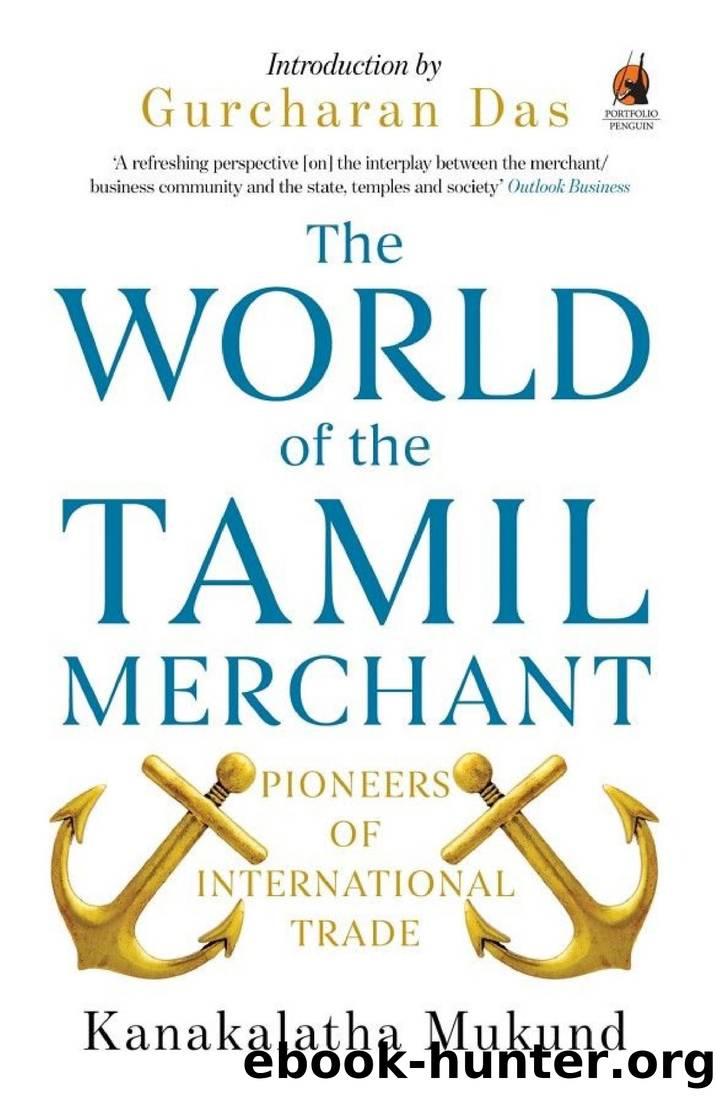
Author:Kanakalatha Mukund
Language: eng
Format: azw3
Tags: Business & Finance, Entrepreneurship & Small Business, Career Planning & Job Hunting, Entrepreneurship
ISBN: 9788184756128
Publisher: Penguin Books Ltd
Published: 2015-05-15T00:00:00+00:00
CULTURAL AND COMMERCIAL CONTACTS: SOUTH-EAST ASIA AND CHINA
Diplomatic and commercial contacts with the kingdoms of South-East Asia dominated the foreign policy of the Tamil kingdoms from the time of the Pallavas. Occasionally, the kingdoms also followed an aggressive route of military intervention which served both strategic political and commercial objectives, albeit with limited success in the short run.
The Hindu kingdoms
From the middle of the fourth century CE, various kingdoms of South-East Asia extending from Thailand to Vietnam in the east, and the Indonesian islands in the south, were ruled by Hindu kings of Indian origin,26 so that the region virtually became a ‘greater India’.27 The presence of Indians in the South-East Asian countries was not confined only to rulers; military officials, priests, Brahmins and traders and professional craftsmen had also migrated to these countries, as can be noted from the corpus of inscriptions discovered across the entire region. This overseas expansion did not come about as a result of military conquest. The experience of the naval attacks on the Sailendra empire and even in Sri Lanka, which is much nearer to south India, proved that such victories tended to be of short duration and colonization or control built on military initiatives was not sustainable. The expansion based on commercial and cultural interactions, on the other hand, was long-lasting. The most outstanding visible monuments of this cultural synthesis are to be seen in the magnificent temples of Angkor in Cambodia, built by the great Kambuja king Suryavarman II in the twelfth century. However, there are many other lesser monuments all over South-East Asia which attest to this synthesis.
Initially, Hinduism spread rapidly in all South-East Asian kingdoms primarily because the kings were Hindus and also because religious teachers from India helped propagate Hinduism under the patronage of the kings. Indigenous social and religious culture was also conducive to the assimilation of Hindu beliefs and values. Gradually Buddhism took root in these kingdoms and has remained the major religion in most countries in South-East Asia from Burma to Vietnam, the only exceptions being Malaysia and Indonesia where Islam is the major religion.
For more than one millennium, these kingdoms retained strong links with India through religious and cultural interactions. However, China was the great empire and political power for the entire region and embassies were regularly sent to the Chinese court by all the kingdoms—Champa, Kambuja and the Sailendras of Sri Vijaya—which implicitly acknowledged the superior status of China as a superpower both politically and economically. The embassies sent to China by the Chola emperors, Rajaraja I in 1015, Rajendra I in 1033 and Kulottunga I in 1077, in effect accepted the centrality of China for maintaining the political and economic power balance in the region.
The nature of Indian influence in South-East Asia can be seen in the inscriptions that have been discovered throughout the region. The preponderant majority of the inscriptions are in Sanskrit and more than thirty inscriptions on stone and many on other artefacts, especially votive offerings on clay tablets or gold leaf, have been discovered in Vietnam, Laos, Malaysia, Indonesia and Thailand.
Download
This site does not store any files on its server. We only index and link to content provided by other sites. Please contact the content providers to delete copyright contents if any and email us, we'll remove relevant links or contents immediately.
International Integration of the Brazilian Economy by Elias C. Grivoyannis(111078)
The Radium Girls by Kate Moore(12036)
Turbulence by E. J. Noyes(8057)
Nudge - Improving Decisions about Health, Wealth, and Happiness by Thaler Sunstein(7712)
The Black Swan by Nassim Nicholas Taleb(7137)
Rich Dad Poor Dad by Robert T. Kiyosaki(6646)
Pioneering Portfolio Management by David F. Swensen(6305)
Man-made Catastrophes and Risk Information Concealment by Dmitry Chernov & Didier Sornette(6029)
Zero to One by Peter Thiel(5808)
Secrecy World by Jake Bernstein(4756)
Millionaire: The Philanderer, Gambler, and Duelist Who Invented Modern Finance by Janet Gleeson(4482)
The Age of Surveillance Capitalism by Shoshana Zuboff(4310)
Skin in the Game by Nassim Nicholas Taleb(4257)
The Money Culture by Michael Lewis(4212)
Bullshit Jobs by David Graeber(4197)
Skin in the Game: Hidden Asymmetries in Daily Life by Nassim Nicholas Taleb(4012)
The Dhandho Investor by Mohnish Pabrai(3775)
The Wisdom of Finance by Mihir Desai(3754)
Blockchain Basics by Daniel Drescher(3586)
